 |
| Designed in 2004, this garden represents a drought-hardy
solution to a unique situation. The home is obviously not an
ultra-modern, contemporary building, and as such, I felt the more
obvious modern, minimalist style of garden would not suit the house.
The low maintenance requirements of my client have been
a major factor in the evolution of this garden design. |
 |
I
wanted the front garden to be very tough and water miserly
because I realized the client’s energy, and focus would be
directed more toward the backyard (which was to be designed at a later
stage), where more time was to be spent (and views of this garden would
be enjoyed from inside all year round).
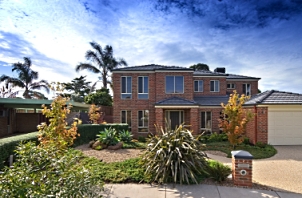
The resultant front garden is a hybrid of modern
and more traditional garden design approaches, which relates to the
style of the home. The combination of house and front garden is an
appropriate picture in the suburban streetscape. Although rain water is
harvested for this garden, the tank size requirement has been kept to a
minimum, and only needed in the event of stage four water restrictions.
|
|
| |
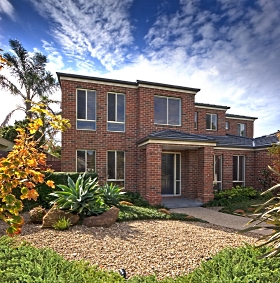
The height of the house is softened by three
specimen trees (Acer Rubrum ‘October Glory’). These
deciduous trees provide vertical texture, whilst maximizing light into
the front of the home in Winter. Their magnificent autumnal foliage
provides interest and the pinkish red colour relates to the
‘redish’ tones of the house bricks.
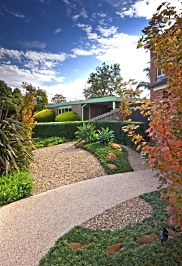
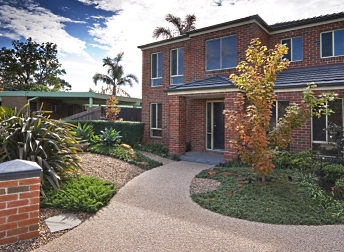
The exposed aggregate driveway and front path provides functional
access for cars and people, without dominating the view of the front of
the house. I felt strongly that to have pavement with a geometric
pattern (brick or tiles, etc) would only have added to the visual noise
of the two storey brick walls of the home. Fortunately, the
discrete, amorphous exposed aggregate provides a subtle yet tactile
element to the front landscape. |
 |
|
|
This tactility is continued by utilizing small river pebbles as the
front ‘lawn’, and larger feature rocks within the mounded
garden beds add even more interest.
An ‘island’ amongst the pebble lawn is formed by a mounded
garden bed which is mass-planted with dwarf Mondo Grass (Ophiopogon
Japonicus ‘Kyoto-dwarf’). This island extends on both
sides of the path to the front door so when one approaches the front
door, the journey has interest, almost as if one is crossing the
different garden elements on a bridge. At one end of this
‘island’, feature rocks form a theatrical base for a stand
out specimen of Agave attenuata. This architectural plant makes a
stunning focal point and is also lit at night.
The garden bed across the front boundary is
mass-planted with a prostrate conifer (Juniperus Conferta), and
this plant has proven to be particularly drought tolerant, and it
provides protection to the soil and plant roots beneath. The prickly
foliage discourages dogs which is an advantage when there is no front
fence, and there is a park next door.
Curved hedges of a native rosemary hybrid (Westringea
‘Wyngabbie Gem’) and box-leaf privet (Ligustrum Undulatum)
provide more traditional structure to the garden, as well as partially
enclosing the garden, thus making it more intimate, whilst maintaining
the drought tolerant theme.
Border planting of another drought-hardy, strap
like-plant (Liriope ‘Magestic’) adds modern texture
to the mix, and Sasanqua Camellias (‘Paradise Blush’),
combined with white Azaleas (‘Alba Magnifica’), have proven
surprisingly drought-tolerant (once established) and further contribute
to the mixture of traditional and modern/architectural plants in this
garden.
|
| |
|
The result is a particularly low
maintenance and drought friendly garden, which
combines traditional and contemporary plants and design structures to
effectively relate the house to its surrounding environment. This
garden illustrates that there is more to drought tolerant gardens than
merely native plants, and that modern garden design can be blended with
traditional elements to enhance a period or older style home.
________________________________________________
This article is an extract/edited version written by
Scott Brown which appeared in Backyard & Garden Design Ideas :
Waterwise Edition Issue 2 October 2007 (p 46-47)
|
 |
|
Brighton
& East Melbourne 03 9596 7244 Fax 03 9596
7844 Email :
design@scottbrown.com.au
|